Author: Angela M. May

  • A sense of beautiful.

    A sense of beautiful.

    I feel a strange resistance this year; a resistance to the pursuit of acquisitions and adventures.  Instead, I feel the need to explore the motto ‘think less and feel more.’ My first quest is beauty.

    I want to behold things of beauty, and send the ugly to the shadows.  Instead of picking scabs and running my finger along the scars, I want to focus on all that is beautiful in between. 

    Beauty by definition is the very quality that brings delight and pleasure to the senses.  Beauty is more than what we see, it is also in what we hear, we taste, we touch and we smell.  It is not always that our senses are not operating. It is that we are not conscious of what they absorb.  It may not be that I need to feel more, but slow down enough to allow my senses to explore. 

    I take in a deep breath, and I smell summer. Freshly mown grass. The air heavy with pollen.  A tickling breeze that carries the smell of barbequed onions.

    I listen, and I hear noises.  Murmuring voices and a saw-mill whirring. And then silence.  But the world is not really silent.  Is that cicadas I hear?  The song of the butcherbird?

    The spices of my chai tea and the sweetness of honey lingers.  I reach for the cut watermelon in the fridge.  The bright red flesh is beautiful, just as its sweetness, that does not disappoint. 

    The day is heating up and the humidity is rising.  The tickling breeze that flutters over my bare limbs is welcomed.  It’s beautiful. 

    I choose to ignore the weeds in my garden, and the grass that needs mowing again.  I spot the butterfly flitting from leaf to leaf, adding a splash of yellow to the green.  How beautiful are the red chilies; glossy and heavy on the plant.  The lime tree is laden with fruit; as always.  I marvel at how one cluster of citrus flowers, sets into a cluster of perfect fruit, growing daily until ready to eat.  Or drop into a cool, refreshing drink. 

    What is beauty to you?  Is it smooth or rough? Is it cool or warm?  Is it light or dark, or coloured?  Is it loud, is it soft?  Or a range of sounds, making music? 

    Is it a matter of perspective?  Is it subjective? I will stop there, because that is too much thinking. 

    The Bible talks about beauty from ashes. (Isaiah 61). How does beauty rise out of grief and loss?  It’s a promise that the God of the Bible has the capacity to take something so ugly and turn it into something beautiful.  I can seek beauty but I am not the creator of it. Co-creator maybe.  Let’s not overthink that either. 

    I cannot replicate the pink and blue hues of a sunset, reflected in the silver trunks of the sentinel gum trees.  If I was an artist, I might paint that, capturing the beauty of the sunset.  If I was a photographer, I might snap that too.  If I was a musician, I might record the song of a bird, or the ripple of a breeze.  No essence replaces the flavour of a ripe watermelon; but a chef can present it to eat. In a world that is presented too often as two dimensional; how do we capture the texture and its depth?  3D does little to replace the experience of being present in the world, with all our senses.  

    Will you join me in finding and restoring a sense of beautiful, implanted in our soul by the Lord.

    “A man should hear a little music, read a little poetry, and see a fine picture every day of his life, in order that worldly cares may not obliterate the sense of the beautiful which God has implanted in the human soul.” ― Johann Wolfgang von Goethe

  • Recalibration and Rest

    Recalibration and Rest

    Weipa was his choice, not mine; but I came along for the ride.  I care little about going fishing or four-wheel driving, but the sunrise and sunsets are divine. The early morning boat ride was glorious. The water mirrored the horizon, and the mangroves that clawed the creek’s bank were not as stinky as I thought. Even the sandflies and midgies stayed in bed as we cruised up and down the estuary, chasing fish, that mostly escaped.  My phone was able to capture some of the moments, but mobile coverage is definitely dim.  This was an added bonus, which meant being in the present, and conversation was on the table again.  I napped like a nanna afterwards; waking in time for dinner at six.  I had no problem with falling asleep again, dreaming deeply in the cabin’s bed.

    I marvel that just one week away from the hustle of home and responsibilities can be so aligning.  Instead of reacting to every interruption, its refreshing to reflect on what is central.  Away from unnecessary routines and even more, the expectations of others; I found the space to reflect on core values and priorities.   For those that speak the language of orienteering, this is the time to get rid of magnetic interference, and recalibrate true north.

    My true north is Jesus, and spending time at his feet.  My values are reflected accordingly. Just being instead of doing allows my soul to catch up with myself; and what a relief!  We only have to be one degree off true north, and before we know it, we can be all at sea.  For me, the rhythm of recalibration seems to be quarterly. I am thankful for a fishing trip to Weipa, that gave me this pause and release.

    A long time ago, I read Stephen Covey’s Seven Habits of Highly Effective People. He drew four quadrants with two axes that explained time management; one for urgency and the other of importance. In my mind, recalibration involves aligning with what is most important, and kicking to the curb the non-urgent. Instead of living constantly alert in the urgent, I make choices to stay on course with the important. This is my true north.  It is not that the urgent is abolished; not at all! But, sometimes, by focusing on what’s most important, I can resist the unhelpful disruptions. 

    In assessing the critical, in the quadrant of urgent and important, I discover a list of deadlines that can’t be missed.  My stress levels rise. While I cannot cross these off as inconsequential, I realise that perhaps I need to consider if they should even be mine. That may mean delegation, or simply establishing my boundary lines.   

    In assessing the urgent but not important, I recognise places of poor planning, along with troubling distractions and interruptions that have been wearing me down to the grain.   By reflecting and unpacking this dilemma, I was able to develop a strategy to relieve some of the strain.   

    And then there’s the non-urgent and non-important; the timewasters that do little to build success. How can I ignore these or bounce them back to their sender, unless I am clear on what’s best?  Again, I go back to my true north, and remind myself what’s most important of all. 

    Last but not least, is the important and non-urgent.  If I constantly live with stress, this quadrant often feels an anticlimax, and not where my efforts should be spent.  Once I recognised this hurdle, I set in motion my next three months of important, before I schedule another rest.  This next time will be in the new year, and one more opportunity to recalibrate my true north. 

    Not to be confused with traveling to Weipa again!  😊   

  • A house is only a home, when it is filled with people

    A house is only a home, when it is filled with people

    ‘Do you want to visit your old family home?’ my husband asked, as we drove past the turnoff, on the remote, dusty road.

    ‘No, I said. ‘I’ve done that before.  What good would it do, to revisit the decay?  Leave it to my memory.’

    Twenty years earlier, an old neighbour had taken me that way. 

    ‘Be warned’ he said.  The last owner stored grain inside, and the cattle have tramped through it.’

    Cow pats lay drying on the aged, grey hardwood of the wrap around verandah.  The homestead was already old before I was born.  The rust on the corrugated roof, and the powdering pastel, green paint was just a bit more. The holes, though, were much bigger. The rain would now fall through and dripping would replace any thrumming.

    It was the size that got me.  I had remembered the verandahs as wide; wide enough for two cars to pass each other. At three, I had a red metal wagon, and my sister, a replica bug of bright red.   We pedaled hard on those wooden boards, keeping back from the outer track and the dangers of the edge with no handrail. The French doors rocking on their hinges were smaller than I remembered.  Dad and I used to stand together under their frame on a dry summer’s night, watching the storms roll across the paddock and the lightning fill up the sky.

    The tank stand that sheltered our children’s afternoon play, now leaned eastward.  I wondered how the tank on the top ever kept enough water to provide for our family.  Any rainfall today would pour through the crumbling sieve that remained sprawled on short, tired stumps below.  Back then, our only water was from this tank or a nearby bore.  Very little was spared for the garden, so the yard did not offer lawn for us children to play on at all.  Instead, there was plenty of dirt to dig holes in, and the clay underneath the tank stand formed the best mud pies. I recalled making bricks for a grandiose cubby house I planned at five. 

    I dared not go inside for fear of falling through a rotten board or encountering one of those snakes my mum would chase with her rifle.  I would rather remember our family home filled with people, rather than mouse droppings, cow dung, and the webbing of now dead spiders. By staying outside, I could smell mum’s baking, hear my brother’s laughter, and pretend I was waiting for my dad to come in from harvesting.  And that old rope spinning in the rafters that would unravel with the tiniest of tugs? Well, I pretended that it was still attached to the wooden swing, that was the joy in my sibling’s laughter.    

    The yard looked much the same as I remembered.  More dirt than green, and more prickles than grass. The wisteria was still there, draped over the sagging, training wire on the verandah; a touch of lilac on a sepia backdrop.   Every now and then, a breeze picked up a bundle of chaff that would tumble over the yard, like the ghosts of my childhood memories.     

    The drum halves, used to pot Mum’s red and orange geraniums, were twisted like the front stairs they accompanied. These rusting relics were from a time before recycling became trendy. No one else came after us to fill them with flowers, and this old Queensland lady was too far gone now to ever belong to another family. 

    I could not bring myself to walk out back.  I suspected the cast-iron, clawfoot bathtub had long been prised out of the lean-to. With the water dried up and the taps rusted shut, I daresay the green frogs who shared this wet room, had long hopped away.   I did not need to see the old thunderbox to know that families of red back spiders had taken up residence.

    Instead, I remembered our Teddy, the black and white Collie dog snoozing in the sun. I saw cats and kittens, guinea pigs and chickens.  Kangaroos and emus.  And wheat in the paddock beyond.  I heard harvesters and diesel generators. I smelled kerosene, the wood fire burning and the lingering scent of first rains on the dust of the freshly plowed paddocks.

    ‘Let’s go’, I said, coming back to the present.

    I left as I came, down a graded track, winding over the creek and through a gate.  As I said to my husband, I would rather remember this old lady as a home, than a derelict house and a hump of corrugated iron and timber.  I agree, that a house is only a home, when it is filled with people.

    To paraphrase a proverb: timber and iron makes a house, but the laughter of children makes a home.

  • The power of scones

    The power of scones

    When was the last time you sunk your bare hands (clean of course) into a bowl of food? I am not advocating bad manners, but rather a sensory cooking experience. It means no gloves or mixing spoons; just your bare hands rubbing, kneading, squishing, and patting.  

    I had the pleasure earlier this year to host a group of young people in my home. I took the opportunity to run a cooking session with them. I determined this session was going to be sensory and social. Scones it would be – the old-fashioned way, where you rub butter into the flour with your fingertips and get your whole hands dirty handling the wet dough.

    I love that cooking involves ours senses, as well as our memory. The smells in the kitchen were amazing. From the crushing and chopping of fresh herbs to the waft from the oven during baking. They say you eat with your eyes first.  While the finished product was not perfect, it did help that they looked edible. And of course, the best part is tasting what you cook. Although, I would argue the best part is sharing with others.

    Scones are reasonably quick to make, quick to bake, quick to cleanup after, and they can be served at any temperature. Warm is the best. That’s how our little group ate them. We enjoyed savory scones (with herbs and cheese), fruit scones (some blueberry, some sultana), some plain and a batch of pumpkin scones. Served with fresh whipped cream, and homemade strawberry and rosella jams, and washed down with a hot cup of tea. We even practiced lifting our cups with our pinkies elevated.

    My mum was the queen of scone baking. She did not need a recipe. If guests arrived unannounced, before the kettle had boiled she would have a batch in the oven. My Mum’s scones were so good the local school asked her to cook for their popular fundraising Devonshire Tea. One year she made twenty five dozen!

    Did you know food memories are more powerful and more sensory than many other memories? Psychologists say this is because these are shaped by all our senses. They are also shaped by the company, the situation and the emotions involved. I agree with psychologist Susan Whitbourne who says, ‘Food memories feel so nostalgic because there’s all this context of when you were preparing or eating this food, so the food becomes almost symbolic of other meaning.’

    The chatter over tea was celebratory. and a definitely a little nostalgic. Some of us remembered our mother’s and grandmother’s cooking from another time and another kitchen table. Some asked ‘are mine the best?’ Who knew that scone baking could be such a competitive sport? Who knew the power of scones?

  • Waiting to Live?

    Waiting to Live?

    When the occasional social media post tugs at something inside of me I make a note of it in my journal, and reflect on it a little further. One such post was titled ‘5 Reasons you might be waiting for your life to start’, by Elisabeth Corey. While Elisabeth’s focus is on recovery from trauma, there is some truth in this for all of us. Too often something in our past hold us back from living in the present.  Perhaps, not trauma from childhood; but, it may be something that happened last year or even yesterday that stops us truly living today. Meanwhile, we exist while we dwell on these things of the past. As Corey highlights, the problem is we wait for someone to apologise, someone to release us, someone to give us permission, for everything to be perfect or for peace to reign.  We are waiting to live.

    Of course, this doesn’t apply only to those living in the past. It can also apply to those living in the future.  We joke when I win the lotto, when I lose these surplus kilos, or find the perfect partner…then I will start living!  It’s like watching the clock for finish time and missing what is happening right now. Or, thinking about what you will say to someone else in the future and ignore the person chatting away beside you.  Crazy hey!

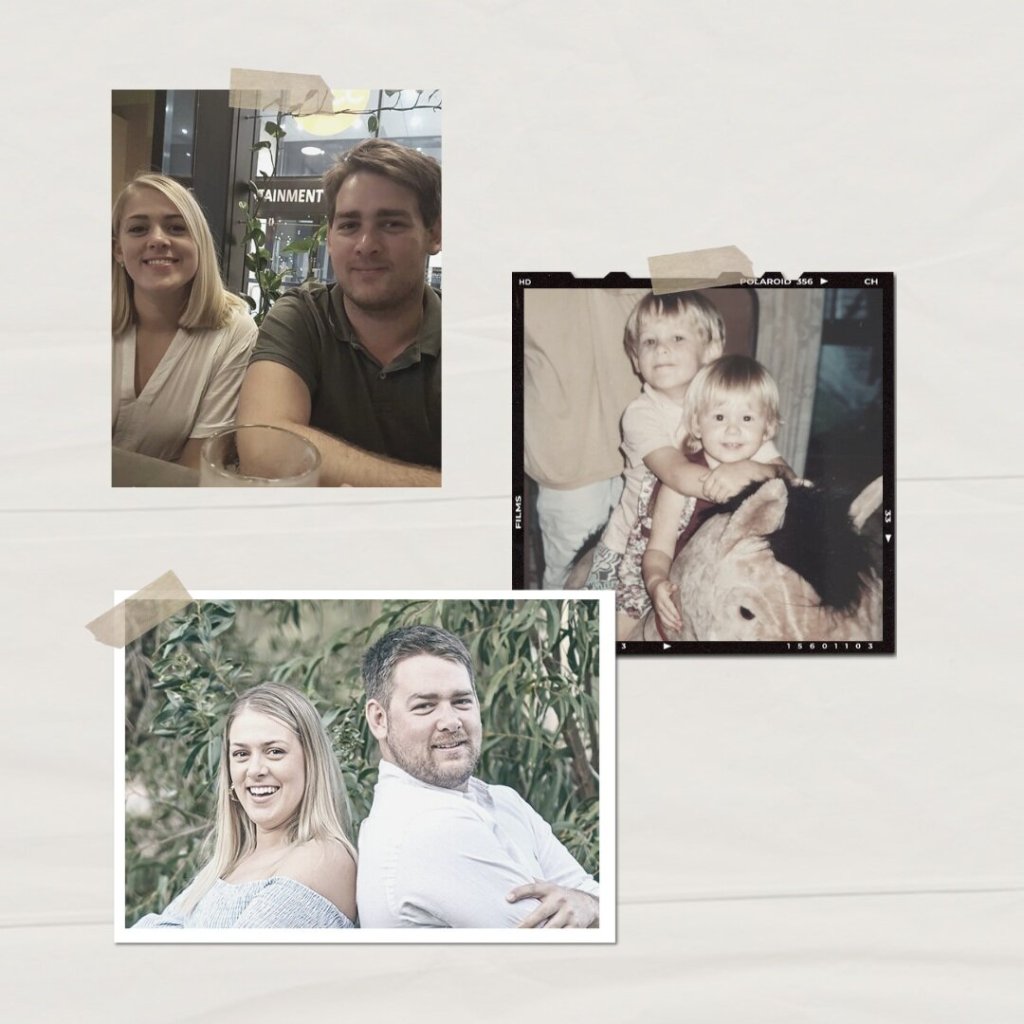
    Before we know it we have existed for most of our earthly lives, and never really lived it.  Sure, you were there in your body, but where was your mind or your soul, at the time?  I should know this as it required piecing together a photo collage, or album, to relive moments of my past; and realising I was present there in body only.  Where was I at the time?  No doubt wishing that something was different or better.  As the saying goes, ‘Be careful, less you wish your life away!’

    Living in the present is the mantra of modern-day mindfulness. There is growing evidence that practicing mindfulness reduces stress and anxiety; so, it is good for both body and soul. This practice involves consciously becoming aware of what is happening inside and outside of one self, without judgement.  While linked to Buddhism, mindfulness is not exclusive to this eastern religion. Nowadays, there is also a form devoid of all religion. Mindfulness, in the form of meditation and contemplation, is also found on the ancient Christian path.

    The Christian version looks a lot like, ‘Be still, and know I am God’ (Psalm 46:10). It is acknowledging that despite chaos and uncertainty, we can find a God given stillness and peace. By opening up we make space for God. In this space we have the ability to hear from Him and find the grace to obey His word.  Mindfulness is not an end in itself but a way forward. Living in the present is not to discount the past, or refuse to consider the future.  It is choosing to respond to the life that is in the here and now.

    The process of being still allows us to capture those swirling and anxious thoughts, and allow God’s mind – the mind of Christ, to bring forgiveness and truth, healing and wholeness – today.  As Richard Foster says, this is not about emptying our mind, but rather filling it.  Rather than detachment from our life, it is an attachment to God and a redirection of our lives. Of course, this is not always a comfortable space.  Keeping God at arm’s length, or leaving him out of the whole mindfulness exercise, is to live life on our own terms.   Some of us would much rather hold onto grudges, blame others for our failure to take responsibility, wait for a perfect tomorrow, or attempt to forget everything; rather than do what God is asking us to do now – living in His presence. As Richard Foster says in Celebration of Discipline, ‘the aim is to bring this living reality into all of life’.

    What if the difference between existing and living, is not emptying our minds of everything- past, present and future; but, rather filling our minds with the presence of the living God and allowing Him to transform us with His love?  Foster explains that we can do this several ways; attentiveness to God through stillness and silence, by meditating on Scripture, or by meditating on creation. It is in the ‘listening, sensing, (and) heeding the light and life of Christ’ that we find the ability to truly live our life today.  So, what are we waiting for?  Our yesterdays, nor our tomorrows, need not hold us back from living life today. We can do this with God’s help and in His presence.

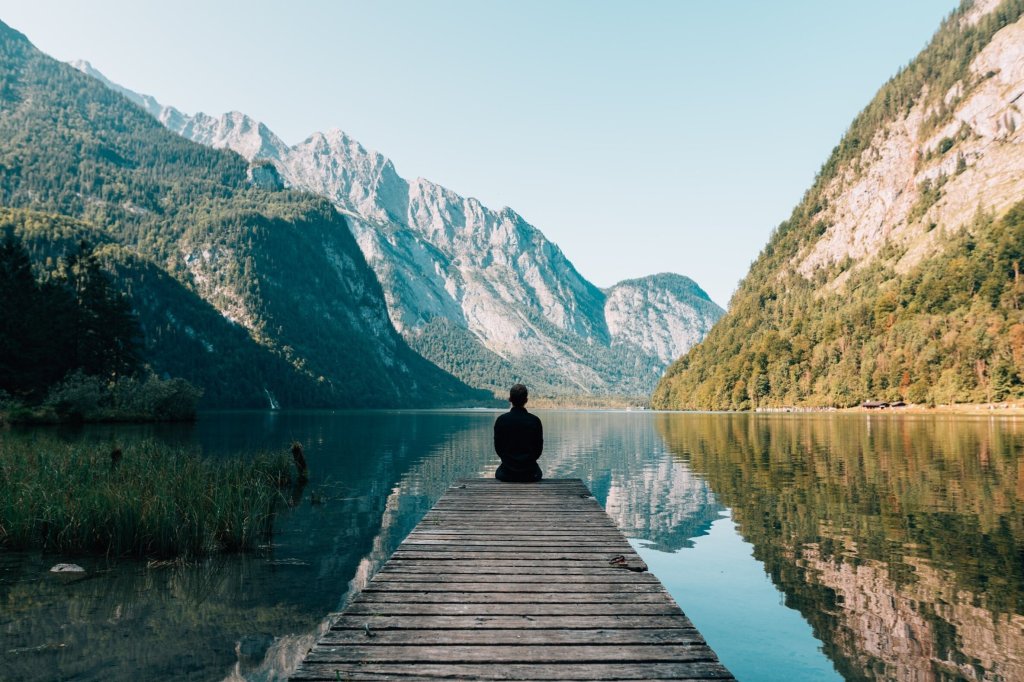
    Photo by S Migaj on Unsplash

    References:

    Corey, Elisabeth. 5 Reasons You Might be Waiting for Your Life to Start. Jun 6, 2018. https://beatingtrauma.com/2018/06/06/5-reasons-you-might-be-waiting-for-your-life-to-start/?fbclid=IwAR0Ak49X5S0nij4hlz1gkxCtdtaVndl2fWORQwDYUafxEJWpQtd3tIwq9hE

    Foster, Richard J. Celebration of Discipline: The Path to Spiritual Growth. San Francisco: Harper & Row, 1988.

  • Rowing in Circles? Stop and Look up!

    Rowing in Circles? Stop and Look up!

    Once upon a time, there was a man who rowed a boat in circles, until he stopped from exhaustion.  When he looked up and realised what he had done, he wept.  If he had looked before then he may have been able to redirect his strokes, so he could have arrived on the shore at the end of the lake – the very place he set out for in the beginning. 

    This week, I visited my doctor to discuss my general health.  I felt like that man on the lake. I go to work to pay the bills to recover my health, that I sabotaged by working hard in the first place.  Just how do I correct and redirect my strokes, to ensure I don’t end up in that exhausting loop again?  That seems to be my eternal question.   

    They say in business, one should take some time out to work on your business, instead of in it.  Instead of head down laboring away non-stop, one should look up to check one’s bearings, plotting the course ahead; and, preventing going in circles. 

    The New Year is always a good time to plot one’s course.  I’m sure the man in the boat did that also.  The question is, how often should you check on those plans, to make sure you are heading in the right direction? 

    I liken my Sundays to my Sabbath rest; a time in the week to stop work and lift up my head. I like to use this time to fix my eyes on life’s race set before me; checking my bearings and resting up, before starting the course again on Monday. I say like, because that’s my desire but not always what I do.  Unfortunately, I sometimes see Sundays as another day I have available. A day to row a little harder, to push through the hard waters, and remove a few obstacles.  The problem is, if I do that too often, I forget the importance of rest and looking up; and find myself in that same pattern of a circle.

    Experts suggest a number of answers.  It starts with clear goals, made visible, and checked every day. Once a week is important as well.  It helps to keep your goals short and simple; and helps the process stay sweet.  Big picture goals are great.  While, too many details can add to your stress. Who wants to be burnt-out or exhausted, from trying to keep up with all those goals that you set?

    And then there’s grace. As a person of faith I breath in, then out, knowing that I may have many plans, but it’s the Lord’s counsel that will stand (Proverbs 16:21). Without His overall wisdom and will, I may never break out of rowing in circles, or stop setting goals that are impossible to meet.

    Keeping to the analogy, the man in the boat thought it was all up to him.  If only he acknowledged the keeper of that lake, and the currents and that wind that could have worked with him.  Old patterns are hard to break especially for those of us that are used to doing it our way – the hard way.  Working hard is good. Rowing hard – for a while, may help.  But what good is a journey if you stop half way exhausted, and all you do is spin in circles. With God’s help, that man – and I, are pausing mid-year (well it’s nearly mid-year), to reconsider the plan, and commit it to the lake’s keeper.  How’s your year going?  Are you on track, or spinning in circles? 

     Photo by Eugenia Romanova on Unsplash

  • Thank you God for the two who call me Mother.

    Thank you God for the two who call me Mother.

    This Mother’s Day I am thankful for the two who call me mother. I have been a mother for a longer time than not; so, I don’t know what not feels like anymore. Being a mother is also a significant part of my identity; and for a long time, the largest part.  I acknowledge that not all women get to be a mother, and for this reason I am especially thankful to God, that I have the privilege of being called Mum. 

    Falling pregnant was easy for me.  Being a mother was much harder.  In fact, after the birth of baby number two, I was diagnosed with postnatal depression.  The complexities of my relationship with my own mother, and the twenty-four seven demands of mothering two infants met in the middle, and my edges started to fray.  For many years I tried to juggle it all, so I could have it all; family and career – or business, in my case.  I yelled at my little ones, and oftentimes expected more of them, and myself, than was good for them.  I wish I knew different back then.   

    Ten years into this mothering gig, I made a commitment to follow Jesus, and started to ask what that meant for me as a mother.  I realised then, that I had actually abdicated most of the raising of our children to other people.  Between childcare, school teachers, Sunday school teachers, music teachers and sport coaches, I was little more than a taxi – and an irritable one at that.  

    It was not until I found myself homeschooling our children, that I realised how much our little family had become a bunch of individuals, with little connection to each other.  One day, turning to two squabbling siblings in the back seat of our sedan, I said, ‘You two have to learn to get along’.  Until then, I relied on other people to deal with my children’s behaviours and needs, and was relieved to send my two back to school, after holidays. This was the beginning of a season, where I took on the full responsibility of mothering our children.  As difficult as some of these days were, I valued every one of them. And just when I found my rhythm, I had to let go. I had to start to delegate some of the raising of my children to others.   I look back now on those years, and thank God for the memories our little family built together; all because I trusted Him to show me how to mother. 

    I learnt to pray for my children as teenagers, and I had to learn to let go and stop smothering.  I watched with fascination as God brought into my son’s life other men, to call him out from under this mother’s wings.  Men, including his father, called him to a life of adventure and the opportunity to be a man. Letting go of my son was one of the hardest things I had to do. But, this rite of passage was wanted. 

    As a mother of a daughter, I wrestle to model a different way; to leave a different legacy, to that of my own mother’s.  As much as I loved my mother, and she loved me, our complex relationship was threaded with unhealthy dependencies, and a poor mental health legacy.  Desiring to be a good mother, with the help of God and the counseling of others, I faced and dealt with stuff.  If I was not a mother, I do not know if I would have the courage enough.   

    For a few, special years, I got to mother another – a son by another mother.  I learnt something else in this season. I learnt to love without, dare I say, owning another.  And I am also reminded, that while motherhood is not assured to all, for those that are blessed, it is a privilege and one of the biggest gifts of all.  

    Who I am today, is intricately linked to who I am, as a mother.  I have the privilege of being wished ‘Happy Mother’s Day’’today, by a thirty-year-old man and his twenty-eight-year-old sister; who is also his friend. 

    Thank you, God, for helping me to be a mother.

    P.S. And thank you God, that I am now a grandmother.

  • The problem with thinking big

    The problem with thinking big

    I have been thinking a lot lately, and struggling to act on a lot.  There seems to be no end of good works, great ideas, and amazing opportunities that others think I should get involved in.   I am drowning in ideas here, dabbling in a few, and feel like I am missing the big opportunity.  The crazy thing is that all this thinking makes me anxious; especially, when I am thinking about what is stopping me taking action.  Could this be a classic example of paralysis from analysis? Is it my reluctance to live in reality?  Is it my fear of failure?  Or maybe, the fear of thinking too small?  Or maybe, it is none of these at all!

    I recall as a little girl, spending lots of time daydreaming. When I was not daydreaming, I had my head in a book.  In my dreams everything is beautiful and stress free; unlike much of reality.  In the books I read, most mysteries were solved, and the girl got her guy, and lived happily ever after. 

    If you know me well you know I am contemplative.  People of action often accuse me of overthinking or overanalysing.  Some experts would suggest that I am using a coping mechanism, learned from childhood. Instead of helping, it is hindering me, by contributing to those levels of anxiety. 

    Research suggests, one strategy to get this overthinking under control is to get out of my head. Well, that’s obvious. What do I do instead? Speak to someone? My friends are good for this, as are therapists.  Write it down.  That definitely helps me.  And trust my gut?  I find this one the scariest to acknowledge, because I might have to believe in myself.

    Surely, there is some good that comes from thinking a lot?  I would think that wouldn’t I? I believe thinking lots has helped me to become better organized, more strategic in my planning, and has contributed to my creativity. At some point in time though, it is important I act on some of this thinking.  My problem, is where do I start.     

    This is when I say, I just want to win the lotto, or receive an email from God telling me what I should do that will guarantee success, so I can safely take action.  And then I realised, who made the goal success?  What if the goal is growing in character, and not everything to do with achievement or reward?  The Bible tells us, suffering brings perseverance which leads to character, and hope.  Now, this Scripture isn’t about dreams and hopes, but more about the deeper soul work of hope in the Lord.  But it does give insight into hope with a little ‘h’.  Dreaming is safe, because it avoids the pain of reality.  Action, often involves a level of suffering with no guarantee of success; but plenty of opportunity for growth. 

    This surely is the game changer.  Instead of stressing about which good works, great ideas and amazing opportunities will guarantee success; perhaps I should ask myself, which one will provide me with the most opportunity to grow?  And, what if the pressure to find the big opportunity is actually holding me back from following through with the small ideas – and humble opportunities, that are in my heart to do?  Instead of listening to what others think I should do, perhaps it is time to listen to the small, quiet voice!

    I would rather be what God chose to make me than the most glorious creature that I could think of; for to have been born in God’s thought, and then made by God is the dearest, grandest, and most precious thing in all thinking.” This is a prayer of contentment” -― C.S. Lewis

  • It Takes Courage to Change

    It Takes Courage to Change

    Do you ever get tired of change?  I do.  I have always thought of myself as a person open to growth, and a proactive person; but I am growing weary.  I worked for an organisation which navigated its way through an enforced change process, followed by another organisation, that grew so rapidly, that change was inevitable.  My bookshelves testify to an adult lifetime of personal development, which I equate with having an openness to change.  I have also sought counselling and professional supervision to help me grow emotionally and personally.  In spite of these many decades of experience with change and a determination to have a positive attitude to it, I have felt that there are no assurances that I will always handle change well.

    To start with, I am not sure my brain has been the best one wired for change.  Those of us that are wired for routine, struggle with change more than others who aren’t.  This is quite an irony, because if you want to make a positive change, you best build new habits, which usually involves routine.  Apparently, some of us get stuck in this routine and need a bit of a nudge to accept change; whether externally or internally required.  As Tami Forman says, routines are great because they reduce decision fatigue, keep you disciplined and generally make your life easier. Unfortunately, when change is required, these routines can hold us back.

    In her article called ‘The Psychology of Change’, Eva Ryker suggests that our attitude and the attitude of others (yes, peer pressure) plays a big role in our ability to change. The biggest contributor is our intention to change.  This is known as a growth mindset, rather than a fixed mindset, and supports behavioral change.

    Unfortunately, as we get older, we have a tendency to become more fixed in our thoughts and our ways.  It is not just teenagers who are sensitive to the opinions of others.  Change, especially personal development and growth, takes even more courage as we get older.   Not only are we often in routine ruts, but we can risk losing friendships and the acceptance of some others, when we become someone different. Perhaps, we have more to lose?   Jeffrey Bonkiewicz says it all in his article’s title: ‘It takes courage to change: Taking on new behaviours can be unpopular.’

    For all of my years of openness to personal growth, I have started to wonder if it is actually a perfection trap? God knows, this side of heaven, I will never be perfect.  So why even bother?  Is it even necessary to change, I ask? I even began to wonder if the personal development industry isn’t a scam. Wisdom has prevailed though.  Growth and change are inevitable, I read, including my own personal decision and willingness to change.  Personal growth, and therefore change, is a lifetime process rather than a bucket list item. 

    Change requires courage, especially in the face of pain and grief.  I guess we would all embrace change if we knew there was no suffering involved.  ‘Courage’, Brene Brown says, ‘is a heart word’; ‘it equals vulnerability.’ In fact, vulnerability, she says, is the birthplace of change- and innovation and creativity.  

    As a Christian, I believe that I serve a God that encourages change, and one who admires courage.  While the process of change is not promised to be pain free, we are promised that we will not be alone in the journey.  God will be with us. The Apostle Paul, in his letter to the Roman church, says that our transformation occurs by the renewal of our minds.  Thoughts and beliefs clearly impact our behaviours. This change that Paul talks about is not for the sake of change itself, or for some personal self-actualization. This transformation process is for the greater purpose of living a life for God’s purposes.  

    Fixed mindsets and fixed ways are clearly not the way forward.  An attitude of openness, of vulnerability, and of the heart, is what we need to be able to navigate the seas of change. I am sure humility and teachability should also be on this list.  I am convinced that my growth, especially in character and behaviours, has, and will continue to occur, not because of my successes, but rather through the setbacks and challenges.  And whenever I find myself growing weary, I may need to reacquaint myself with God and God’s vision and purpose for my life.   By fixing my eyes on His greater purpose for my life, in Christ Jesus, I will find the grace and the endurance to continue to run this race called life. 

    As John Assaraf says ‘anyone can stay the same. It takes courage to change.’

    Don’t give up! 

    Photo by Evie S. on Unsplash

  • The gift of belonging to a bigger story

    The gift of belonging to a bigger story

    As a young girl, I spent many afternoons after school sitting in my grandparent’s caravan, sipping milky sweet tea, and dunking biscuits.  The challenge was to dunk those biscuits just long enough to soften them, without them landing in the bottom of my teacup. Pop needed to dunk his biscuits for lack of teeth. I did it because he let me.  

    Nan made the pot of tea; brewed with tea leaves and freshly boiled rainwater.  She also stocked up on those dunking ‘bikkies every pension day shop.  Arnott’s, I recall; Scotch fingers and Gingernuts. 

    My Pop was a storyteller. He loved to yarn about his childhood and his working days, along with stories of farms and family. He listened to my stories as well and answered my many questions. My grandparents gave me the gift of belonging to a bigger story- our family’s story.     

    I never got to hear stories from my Dad’s parents.  Grandad died before I was born, Grandma died when I was nine.  It wasn’t until later in life that my Dad would tell me stories about Grandma, and his childhood. Books printed for family reunions, told stories of my German and Protestant ancestry, giving me a larger framework to understand the stories of this side of my family.   

    Michael Jensen  says storytelling is the impulse that lies deep within human cultures, to the point that it is almost fundamental to the very concept of our culture itself.    We belong to bigger stories than just our own.  Both the bigger story and our own stories help us create meaning.

    I have a friend who is adopted. She has never heard stories from her biological grandparents or birth mother.  I do not understand what that is like.  She has very few stories of her birth, her abandonment, and little opportunity to gain another perspective.

    Gaining another perspective involves hearing another’s story. This is helpful to reframe some of our own negative stories and can bring new meaning and healing.  For over forty years, I believed a story that I said I was not lovable.  This story was based on fragmented memories of abandonment.  It was not until decades later, when my mother told me another story, that I realised my version of the story was incomplete.   

    I have found journaling helpful to reframe some of my stories.  Often, I get stuck on one grievance or perspective and cannot get past my story of hurt and disappointment.  By asking different questions of my day, or year or season, I inevitably end up with a reframed version of my story.   I will often ask myself, what do I have to be grateful for, what have I learned, and what is God saying to me in this?  Questions like these help me to gain a different perspective, and brings deeper meaning to the stories of my life. 

    As a Christian, I believe I belong to a bigger story; and this grand story helps me make sense of both the beauty and the brokenness of my life, and the world I live in. When I view my life through Jesus Christ, all the little stories of my life have purpose and meaning.   

    One day, I hope to tell stories to my grandchildren, just like my Pop did all those years ago.   I hope that I can share a little of the bigger story with them, so that they may know a sense of belonging as well. I want to serve them tea and bikkies, and listen to their stories too.

    Photo by pine watt on Unsplash